From the stethoscope to the pocket ultrasound scanner, medicine has come a long way toward immediate diagnosis. Today, the handheld ultrasound represents the new frontier of speed and accessibility.
The evolution of immediate diagnosis
The idea of obtaining a diagnosis directly “at the patient’s side” stems from the desire to make medicine faster, more accessible, and closer to people.
After centuries of observations and trials, in 1816 René Laennec, with the invention of the stethoscope, inaugurated a new era: for the first time, the doctor had a portable tool capable of extending his senses, listening to what was happening inside the body.
Throughout the 20th century, the introduction of radiology and ultrasound made rapid diagnosis more accurate , although it also made it more dependent on complex technologies and large hospital departments . The decisive change came with electronic miniaturization and the widespread adoption of laptops: this led to the development of instruments such as the first compact ECGs and rapid tests for detecting infections and pregnancies, taking diagnosis out of the laboratory and directly into the hands of physicians.
With the advance of the new millennium, the miniaturization of diagnostic devices and connected digital tools allowed a further step: equipment such as portable blood gas analyzers or multiparameter monitors now offer immediate results, directly in an ambulance, in the consultation room or even in the field.
Among the most recent and promising innovations is the handheld ultrasound scanner, which concentrates the power of a traditional ultrasound in the palm of your hand.
What is a handheld ultrasound scanner?
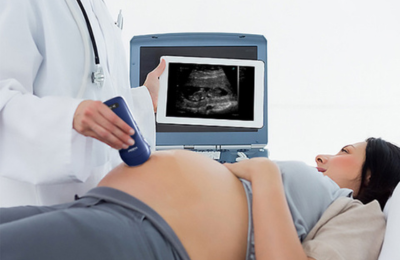
An ultrasound scanner is an instrument that uses high-frequency sound waves (ultrasound) to create real-time images of the inside of the body. The distinguishing feature of the handheld model is its compactness: it can literally fit in the palm of your hand or in a lab coat pocket, just like a stethoscope.
The device connects to a smartphone or tablet, where a dedicated app displays the ultrasound images in real time. Through the same interface, images and reports can be shared with other professionals, making diagnosis a collaborative and immediate process.
This technological integration opens up new diagnostic and care possibilities, making ultrasound examination accessible in increasingly diverse contexts—from the doctor’s office to emergency rooms or even out-of-hospital settings—.
Although it does not replace high-end ultrasound scanners, equipped with advanced Doppler functions and greater penetration depth, the handheld ultrasound scanner is distinguished by its versatility, speed and ease of use.
Main uses of a handheld ultrasound scanner
Designed to make ultrasound accessible anywhere, portable ultrasound scanners represent today the frontier of faster and more patient-centered medicine, capable of bringing diagnosis to where it is most needed: from emergency rooms to the home.
Its main areas of application are:
- Hospital emergencies and urgent care: in ambulances or emergency rooms, they allow for the rapid recognition of effusions, pneumothorax or cardiac abnormalities, improving the speed of intervention.
- Outpatient and community medicine: ideal for kidney, gallbladder, thyroid checks or for monitoring ascites and heart failure, they reduce the need for more complex tests and speed up the diagnostic process.
- Intensive care and anesthesia: used to guide invasive procedures, verify the correct placement of catheters and evaluate the patient’s hemodynamic status, are now part of the international POCUS (Point-of-Care Ultrasound) protocols.
- Rural areas and humanitarian missions: thanks to their portability and wireless connectivity, they allow ultrasounds to be performed and shared even in areas without hospital equipment, expanding access to medical care.
Recommendations for getting the most out of a handheld ultrasound scanner
To fully exploit the potential of portable ultrasound scanners, it is essential to invest in continuous training, keeping the skills of professionals up-to-date and ensuring conscious and accurate use of the device.
Regular training programs, even short and specific ones, can reduce interpretation errors and improve diagnostic quality, especially when using entry-level models.
At the same time, it is advisable to address infrastructure challenges—such as energy availability, maintenance costs, and connectivity—through modular and sustainable solutions, adapted to resource-constrained environments.
Work organization also plays a key role: integrating the use of the portable ultrasound scanner into daily clinical workflows, while avoiding overloading staff, promotes wider adoption and more effective use of the instrument.
Finally, it is important to remember that the handheld ultrasound scanner complements, but does not replace, high-performance systems: in complex examinations or those requiring high resolution, synergy with traditional equipment remains the most effective strategy.
The future of rapid diagnostics
The prospects for portable ultrasound in immediate diagnosis are extremely promising. Next-generation devices will offer greater sensitivity and resolution, incorporating advanced features that will increasingly narrow the gap with traditional ultrasound scanners.
At the same time, telemedicine and tele-mentoring are opening up innovative scenarios: thanks to remote supervision, doctors in rural areas can obtain real-time diagnostic support, improving access to care and reducing diagnosis times.
The portable ultrasound market is expected to grow significantly in the coming years , driven not only by technological advances—longer-lasting batteries, stable connections, and multi-platform compatibility—but also by new access models based on subscriptions and partnerships with telemedicine platforms.
All of this will make these devices increasingly accessible to peripheral clinics and frontline professionals.

I am an MBBS student and medical content writer specializing in health education, medical research, public health awareness, and informational guides. With a strong foundation in clinical knowledge and evidence-based medicine, I write accurate, SEO-optimized, and reader-focused articles. My content covers healthcare topics, medical updates, government welfare programs, and educational resources to help readers access reliable and up-to-date information. I am committed to delivering trustworthy, well-structured, and search-engine-friendly content that adds real value.

Pingback: From the first impulses to 3D ultrasound: the birth and evolution of ultrasound - DRKWRITE